The $14 Million Did Not Go to Yola
Nigerian coverage of this story still puts the money in Atiku’s university. It went to a university in Washington, D.C. — which took it for five years from offshore companies it knew nothing about and, by its own account, never asked why they were the ones paying.
Start with the correction, because it is the whole article.
Ntufam Hilliard Eta listed the $14 million on 8 September, and he described it carefully: money “transferred by offshore corporations to American University in connection with consulting services relating to the establishment of the university in Nigeria.” The Nigerian Tribune’s report of the same press conference told its readers something else. It said the money had gone to “American University located in Yola, Adamawa State and owned by Atiku Abubakar.”
It is an easy slip, because the two institutions share a name. It is also wrong.
The report says this, on page 3:
“In addition, two of the offshore corporations wire transferred about $14 million over five years to American University in Washington, D.C., to pay for consulting services related to the development of a Nigerian university founded by Mr. Abubakar.”U.S. Senate Permanent Subcommittee on Investigations, 2010 report, p. 3
Washington. Not Yola. And the case study is more specific still, on page 187:
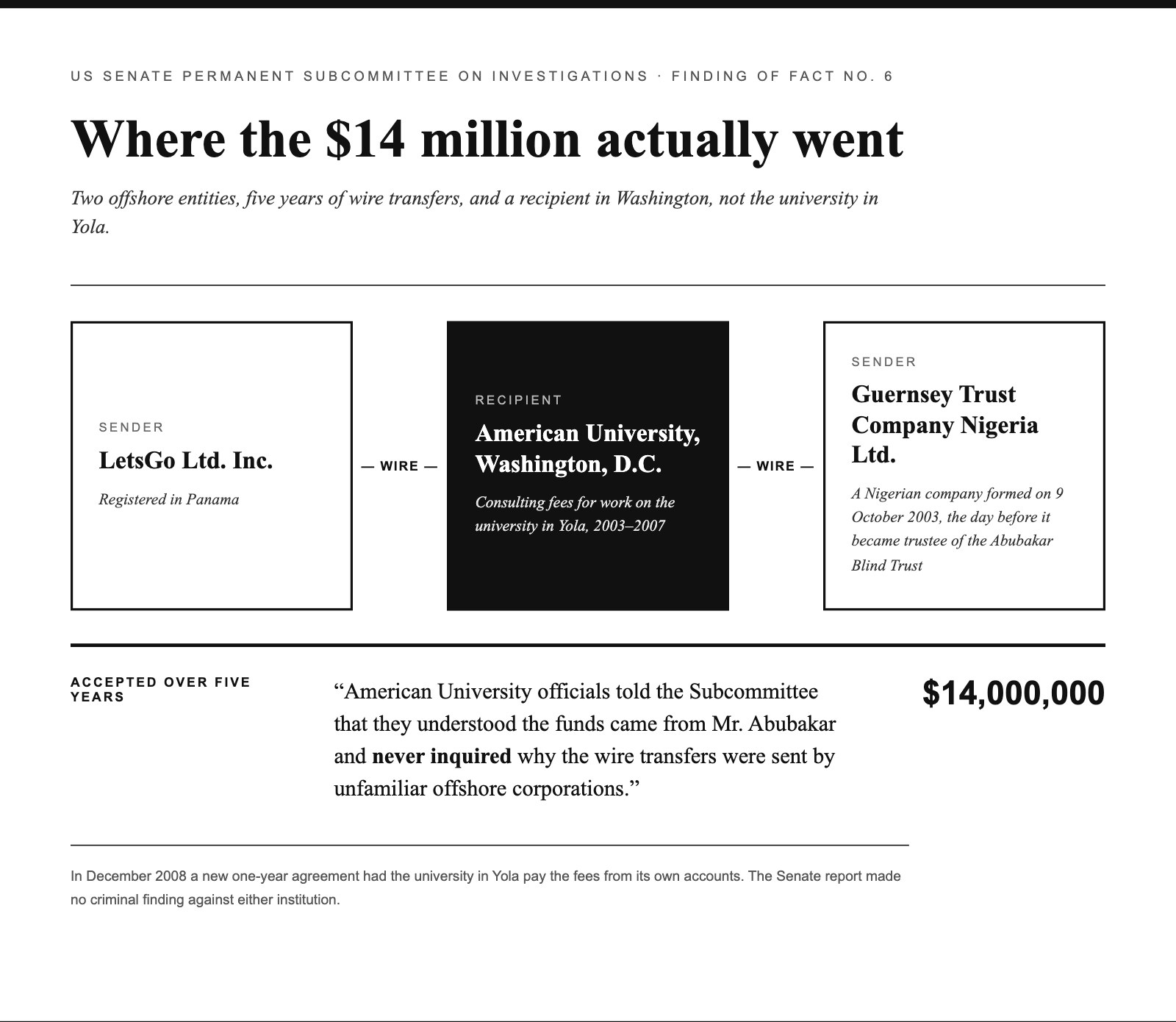
“From 2003 to 2007, American University accepted about $14 million in multiple wire transfers from LetsGo and the Guernsey Trust Company, to pay consulting fees for its work related to AUN.”U.S. Senate Permanent Subcommittee on Investigations, 2010 report, p. 187
The money did not go to Atiku’s university. It was paid for Atiku’s university, to an American institution that was advising on how to build it.
This is not pedantry. The two versions describe completely different events. In the Yola version, Nigerian public money is suspected of ending up inside a private Nigerian asset — which would be, if proved, a straightforward theft. In the version the report records, money the Senate subcommittee classed as suspect funds was sent by a Panamanian company and a Nigerian shell company into the accounts of a respected American university, which accepted it for five years on the understanding that it was Atiku’s, and never asked why offshore companies were the ones sending it.
The arrangement
Atiku Abubakar founded the school in Yola while he was the sitting Vice President of Nigeria. By AUN’s own account, it was licensed in 2003 as ABTI University, became ABTI American University of Nigeria, and took the name American University of Nigeria in 2007. Its first intake, in the 2005–06 session, was 124 students.
The “American” in the name is not decorative and it is not ownership. By AUN’s account of its founding, Atiku “approached the American University (AU) in Washington, DC, for advice and assistance in establishing an American-style university.” The Senate report adds that it was Jennifer Douglas, then a doctoral student at AU, who first approached the university, in 2002. AU in Washington is an entirely separate institution. What existed between them was a consulting relationship — expertise sold, fees paid — set down in a five-year management consultancy agreement signed on 31 December 2003. Atiku’s lawyer told the Subcommittee that he had spent about $150 million of his own money establishing and running AUN.
The fees are the $14 million.
Who sent it
Two entities, both familiar from the rest of this file.
- LetsGo Ltd. Inc.A Panamanian corporation which, the report says, is beneficially owned by Gabriele Volpi, Atiku’s business partner, and members of his family. American University told the Subcommittee that it received about $13.1 million from LetsGo.
- Guernsey Trust Company Nigeria Ltd.A Nigerian shell company that the Senate report describes as “formed one day earlier under the laws of Nigeria”: it was created on 9 October 2003, the day before it replaced a Panamanian company as trustee of the Abubakar Blind Trust. American University received about $900,000 from it.
Neither is a university. Neither is a government. Neither is a person. A university in Washington did consulting work and was paid for it, repeatedly, for five years, by a company registered in Panama and a company formed in Nigeria the day before it became a trustee.
There was also plumbing on the American side. In April 2005 Jennifer Douglas opened a Citibank checking account in her own name that was later restyled “Jennifer Douglas/ABTI American University.” A second account followed in January 2006, and in February Buford George Peterson, AUN’s Vice President of Finance and Administration, was added as a co-signatory. About $5.5 million in LetsGo transfers went into the first of those accounts. In 2008 the Abubakars’ Washington lawyer helped open an AUN account at SunTrust, agreed to serve as its signatory, and accepted another $2 million in offshore wire transfers into it.
An account that begins as a private individual’s account and acquires a university’s name is not an ordinary university account. Citibank later told the Subcommittee that it should have been re-categorised as a business account, and that leaving it as a personal account was “inconsistent with [Citibank] practice.”
The answer American University gave
The Senate subcommittee put its questions to American University in 2008 and 2009, through the university’s lawyers and in interviews with its officials. The explanation is recorded in one sentence on page 173, and it is remarkable:
“American University officials told the Subcommittee that they understood the funds came from Mr. Abubakar and never inquired why the wire transfers were sent by unfamiliar offshore corporations.”U.S. Senate Permanent Subcommittee on Investigations, 2010 report, p. 173
They knew whose project it was. They assumed the money was his: AU told the Subcommittee that it had asked Mr. Abubakar or his assistant about the source of the payments and had been told that all of it came from him. What they did not ask was why the sitting Vice President of Nigeria was paying an American university through a Panamanian company and a Nigerian trust company formed the day before it became his trustee.
The report then supplies the defence before anyone else can:
“American University accepted the wire transfers without asking about the identity of the offshore corporations or the source of their funds, because under current law, the University had no legal obligation to inquire.”U.S. Senate Permanent Subcommittee on Investigations, 2010 report, p. 3
That is exactly right, and it is why the Nigerian case history is in this report at all. Finding of Fact number six, on page 5, reads: “A U.S. university accepted over $14 million in wire transfers from unfamiliar offshore shell corporations to pay for consulting services related to development of a university in Nigeria founded by Mr. Abubakar.” The finding is about the university. Its subject is the gap in American law that let it happen. Universities are not banks; the law did not require them to run anti-money-laundering checks on a client, because few people had thought of a university as a place money could be moved through.
American University’s own position, as the report records it, was that it did not believe it had received suspect funds in the AUN matter, and that it was proud of having helped to create the American University of Nigeria.
The tell
Here is the detail that says the most, and it is easy to skim past.
After the Senate came asking, American University changed the arrangement. The report puts it this way, on page 187: “After receiving an inquiry from the Subcommittee about the source of these funds, American University negotiated a new consultancy agreement with AUN in 2008, in which AUN agreed to provide fees to AU directly from AUN’s own bank accounts.” American University told the Subcommittee that it signed the new one-year agreement in December 2008, and the report presents it as a step taken “to prevent future concerns about receiving payments from unfamiliar third parties.”
The original contract had run for five years, so it was due for renewal anyway. What changed was who paid. Read that as an institution reading its own file. From then on, the university in Yola was to pay the university in Washington out of the university in Yola’s bank accounts — which is how it should have worked from the first invoice, and how any bursar in the world would have expected it to work.
What a university is worth
There is a reason the Subcommittee cared about this route, and it has nothing to do with education.
Money moving into the United States from an offshore company into a private individual’s account raises a question at some point — as it eventually did at Citibank, which in 2007 decided to close all of the accounts related to Ms. Douglas, after becoming aware of her status as the wife of Nigeria’s Vice President and of allegations surrounding the couple. Money moving from an offshore company to American University raised no question at all, because the recipient was the reassurance. The transaction read as a school paying its consultants. The respectability of the destination did work that the origin of the money could not do for itself.
If anyone ever wanted to make money look ordinary, that is what would do the work: not the cash, the context.
And this is the trap in the story, because the Yola institution is not a fiction. AUN is a real university with real students, whose programmes the National Universities Commission accredited in 2008, in a part of Nigeria that has lived through more than a decade of the Boko Haram insurgency. At the height of that crisis it helped coordinate the feeding of some 300,000 displaced people around Yola. It gave places to schoolgirls who escaped the Chibok abduction. Whatever else is true, it exists and it functions.
Both things sit in the same file. A genuine institution can be built with money whose origin has never been fully accounted for in public. The good the building does is real. It is also, structurally, the argument against ever asking how it was paid for.
Nobody looked. Nobody has looked since.
Now the part that repeats through every article in this series like a refrain.
- No American regulator acted on itThe Senate report alleges no wrongdoing by American University and makes no referral. It does record one lapse, on page 241. The law required universities to disclose gifts and contracts from a foreign source worth more than $250,000 to the Secretary of Education, and when the Subcommittee asked for copies, American University found that it had “inadvertently failed to file the required disclosures since 2006.” It filed them on 25 January 2010, reporting more than $11 million in additional foreign payments for its AUN work. The filings did not have to name the source, and did not mention Mr. Abubakar, Ms. Douglas, LetsGo or the Guernsey Trust Company. That rule, Section 117 of the Higher Education Act, dates from 1986; according to the Congressional Research Service, the Department of Education began to monitor and investigate compliance proactively only in 2019. We found no public record of any enforcement action over these payments.
- No Nigerian agency has published any examination of itWe could find none from the EFCC, the ICPC or the National Universities Commission.
- AUN has not publicly answered itWe could find no statement from the Yola institution addressing the funding route. Atiku’s latest public comments about AUN defend what the school does — “every child belongs in a classroom, not on the street with a begging bowl,” he wrote, in a post reported on 4 September — and do not address the payment route the Senate report describes.
- Nobody has pressed the obvious follow-upLetsGo and the Guernsey Trust Company sent $14 million to Washington. Where did they get it? The report records the explanations it was given: that the Guernsey Trust Company’s money came from dividends on the shares held in the Abubakar Blind Trust, and that LetsGo’s payments to Ms. Douglas related to what Mr. Volpi called a “moral agreement” acknowledging Atiku’s interest in the oil services company Intels, alongside a line of credit LetsGo had extended to the trust. The report said those arrangements still raised questions. Atiku, through his lawyer, declined to answer any of the Subcommittee’s questions. The question has been sitting in a public American document since February 2010. We can find no record of it being put to anyone in a Nigerian courtroom.
Why the wrong version is so useful
The Yola version survives because it is the more useful one for both sides.
For Atiku’s opponents it is simpler and it hits harder: he moved public money into his own university. It fits on a placard. It is also, on the face of the primary document, wrong — which means that every time it is repeated, his camp can correct it, and correcting a false version of an allegation looks a great deal like answering the allegation.
It is not answering it. The version in the report is still there underneath, unaddressed, and it is heavier: $14 million the Subcommittee classed as suspect funds, sent by two offshore entities to an American university that says it never asked why they were the ones paying — and which, once the Subcommittee asked, negotiated a new contract so that it would not happen that way again.
Nobody in this story has been charged with anything. The report found that the university had no legal obligation to ask where the money came from, though it had fallen years behind on the disclosures the law did require. And that is the finding — that money could move at this scale, for five years, through one of the most reputable institutions in Washington, and the only visible consequences were a new payment clause and a set of late filings.
Next in this seriesThe Tape, the Company That Did Not Exist Yet, and the Job at the Aviation AuthoritySources
- U.S. Senate Permanent Subcommittee on Investigations, Keeping Foreign Corruption Out of the United States: Four Case Histories, 2010, pp. 3, 5, 173–174, 181–182, 186–187, 191–192, 197, 201, 228, 233–236, 241 · hsgac.senate.gov · download the report
- Abubakar case study chapter of the Senate report, standalone scan · almendron.com
- American University of Nigeria, “History” · aun.edu.ng
- Nigerian Tribune, “Atiku fires back as APC chieftain wants EFCC probe over alleged financial sleaze,” 9 September 2026 · tribuneonlineng.com
- BusinessDay, “APC ex-vice chairman demands Atiku’s probe over alleged financial crimes” · businessday.ng
- The Eagle Online, “Atiku responds to criticism over children begging on Northern streets,” 4 September 2026 · theeagleonline.com.ng
- Congressional Research Service, “Section 117 of the Higher Education Act: Reporting of Foreign Gifts and Contracts” (IF12927) · congress.gov
- Council on Foreign Relations, “The American University of Nigeria and the Adamawa Peace Initiative” · cfr.org
- Sahara Reporters, “Four Chibok Girls Among 200 Matriculants At American University Of Nigeria,” 3 September 2018 · saharareporters.com
- AFP Fact Check, “2010 US Senate report recycled as fresh corruption probe into Nigeria’s former VP,” 14 August 2026 · via Yahoo News
The allegations described here are allegations. The Senate report alleges no wrongdoing by American University or by the American University of Nigeria. Neither Atiku Abubakar nor Jennifer Douglas has been convicted of any offence in connection with these payments, in the United States or Nigeria, and both have denied wrongdoing.