Nothing Will Happen. Here Is Exactly How Nothing Happens.
Nigeria rarely acquits its powerful men and rarely convicts them. It does something else, and it has a mechanism, and the mechanism is visible in the big cases of the last twenty years. This is the last article in this series, and it is a prediction with its working shown.
Here is the prediction, stated plainly so it can be checked against us later.
The EFCC will not charge Atiku Abubakar before the election on 16 January 2027. The ICPC will not. The Code of Conduct Bureau will not. There will be no arraignment, no interim forfeiture order, no travel restriction, and no public statement confirming that a case file has been opened.
After the election, one of two things will happen. If he loses, the petitions will decay quietly and nobody will mention them again until the next cycle. If he wins, they will be discovered to have been meritless.
We would like to be wrong. We do not expect to be, and the reason is not cynicism. It is that we have watched this machine run many times and we know every part of it.
The three exits
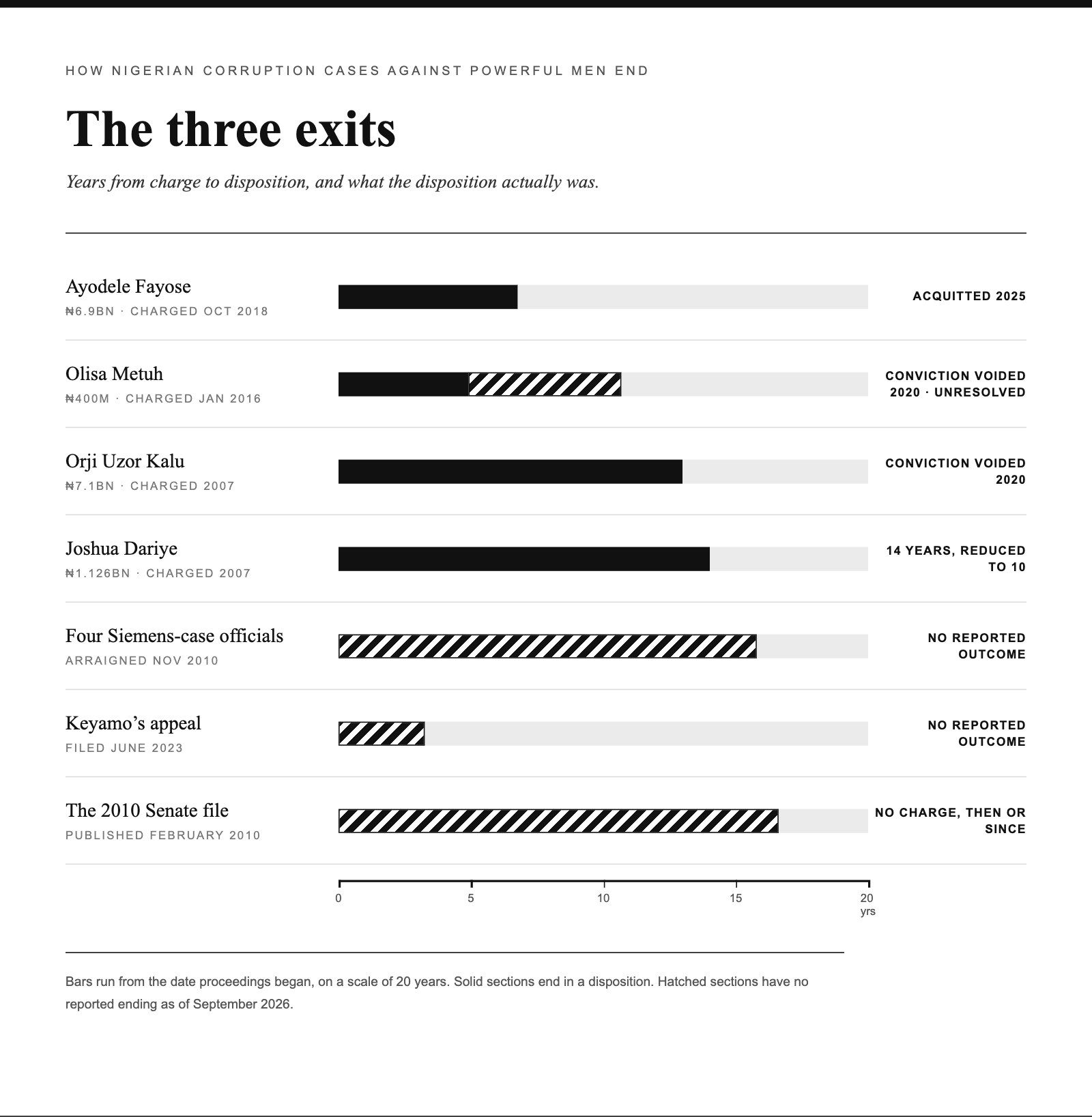
Nigerian corruption cases against politically significant people rarely end in a verdict that settles anything. They leave by one of three doors.
Door one: the seven-year acquittal.
Ayodele Fayose, the former governor of Ekiti, was arraigned on 22 October 2018 — six days after his term, and with it his immunity, ended — on charges concerning ₦6.9 billion. On 16 July 2025 Justice Chukwujekwu Aneke of the Federal High Court in Lagos upheld his no-case submission and discharged and acquitted him, holding that the prosecution had not made out a case for him to answer. Nearly seven years of prosecution, and the state never got as far as the defence having to open. The EFCC said it would appeal.
Seven years is not a trial. It is a sentence of a different kind, served by everyone: the accused, the witnesses whose memories degrade, and the public, which stops paying attention somewhere around year three.
Door two: the conviction that comes undone.
Olisa Metuh, the PDP’s national publicity secretary, was charged in January 2016 over ₦400 million from the office of the National Security Adviser. He was convicted on 25 February 2020 and sentenced to seven years. On 16 December 2020 the Court of Appeal voided the conviction, holding that the trial judge had shown bias, and ordered a fresh trial before another judge. The EFCC took the case to the Supreme Court; in September 2022, with that appeal still pending, the Federal High Court struck out a fresh charge against him as an abuse of process. We could find no reported Supreme Court decision since. Four years to a verdict, ten months to unmake it, and more than ten years after he was first charged, no court has finally settled the case. Last November Metuh joined the APC, saying the PDP had abandoned him during his trials.
Orji Uzor Kalu, the former governor of Abia, was first arraigned in 2007. In December 2019 he was convicted on 39 counts concerning ₦7.1 billion and sentenced to twelve years. In May 2020 the Supreme Court nullified the trial on a procedural point: the judge who convicted him had already been elevated to the Court of Appeal. In September 2021 a Federal High Court judge ruled that he could not be retried, and the EFCC has spent the years since trying to overturn that ruling at the Court of Appeal. He is a serving senator.
Joshua Dariye — from whose diversion of Plateau State funds, according to sworn EFCC testimony, ₦100 million was traced to the company at the centre of the Achimugu tape — was charged in 2007 and sentenced to fourteen years in June 2018. The Court of Appeal reduced that to ten years later the same year, and the Supreme Court upheld the ten-year term in 2021. He is the closest thing this entire file has to a completed prosecution, and even he did not serve what he was given: he was pardoned in April 2022 and left prison that August.
Door three, and the most common: silence.
Four Nigerian officials — a former director of the Power Holding Company of Nigeria, a former chief executive of M-Tel, a former NITEL finance manager and a former permanent secretary — were arraigned in Abuja in November 2010 on a sixteen-count charge of receiving bribes from Siemens, whose 2008 settlement with American and German authorities was then the largest in the history of the US Foreign Corrupt Practices Act. That same month the Federal Government discontinued its prosecution of the company itself, in return for a ₦7 billion penal fine. For the four officials, the court file goes quiet. An anti-corruption group later alleged, in a 2013 petition to President Goodluck Jonathan, that the Attorney General had ordered the EFCC to terminate their case in November 2010. We found no court record of a withdrawal, and no judgment, conviction or acquittal.
Festus Keyamo said, within a day of the dismissal of his 2023 suit, that he was appealing — “the struggle on this issue continues.” We could find no report of that appeal being heard or decided in the three years since, and no trace of whether the ₦10 million awarded against him was ever paid.
Sambo Dasuki was held for four years over the $2.1 billion arms procurement scandal, in defiance of court orders granting him bail, until his release in December 2019. The men caught up in the arms-procurement investigations of 2015 and 2016 moved through years of proceedings. Raymond Dokpesi was cleared by the Court of Appeal in 2021, which held that the prosecution had not made out a case for him to answer. Attahiru Bafarawa, charged alongside Dasuki in 2015, was still on trial with him in December 2025, when the case was adjourned for the cross-examination of the prosecution’s second witness. Alex Badeh, the former Chief of Defence Staff, was shot dead on the Abuja–Keffi road in December 2018, after the prosecution had closed its case and before he had opened his defence.
This third door is the one Nigerian cases usually take.
Why the machine works this way
It would be comforting to say the problem is a weak agency or a slow court, because those are fixable with money.
The real reason is structural, and this series has walked through it four times without naming it.
An allegation is worth more unresolved than resolved. A pending file against a powerful man is an asset. It can be raised when he is inconvenient and shelved when he is useful. The moment it goes to trial, it stops being an asset: it either succeeds and destroys him, or it fails and disarms everyone holding it. Nobody who possesses such a file has ever had an incentive to spend it.
This is why the defection pattern exists, and why nobody in Nigeria finds it surprising. The investigative outlet FIJ has catalogued it. The EFCC opened a probe in 2015 into Godswill Akpabio’s years as governor of Akwa Ibom, on a petition alleging that ₦108.1 billion had been stolen; he joined the ruling APC in 2018. Musiliu Obanikoro, arrested in 2016 over ₦4.7 billion from the office of the National Security Adviser, joined the APC about a year later while his case dragged on. Peter Nwaoboshi joined a week after an acquittal. Ifeanyi Okowa — Atiku’s own 2023 running mate — crossed in April 2025, five months after the EFCC arrested him over an alleged ₦1.3 trillion, and the EFCC had to announce publicly that his probe would continue, which is not a thing an agency needs to announce unless everyone already assumes otherwise.
And currency is not spent on trials.
What would actually settle it
Not a new petition. Not another press conference at Buhari House. Here are things that would move this, in order of how easy they are.
- One: the EFCC publishes the disposition of the petitions it already hasFestus Keyamo petitioned the EFCC, the ICPC and the Code of Conduct Bureau on 16 January 2023 over the special-purpose-vehicle allegations. A former member of the House of Representatives petitioned the EFCC again in a letter dated 27 August 2026, and on 8 September a former APC national vice chairman stood up at the ruling party’s headquarters and demanded that the agencies act. The commission has not said publicly whether the 2023 petition was assessed, by whom, or with what conclusion. Publishing a register of petitions received against public officials and their status — assessed, closed, open, referred — costs nothing, requires no legislation, and would end the argument about selectivity in a single act. Its absence is a choice.
- Two: somebody asks SiemensThe company’s internal records were detailed enough for the US Securities and Exchange Commission to cite about $172,000 in watches for Nigerian officials designated in them as “P.” and “V.P.”, which the SEC said likely referred to the President and Vice-President of Nigeria. The records exist. Siemens settled with American and German authorities in 2008 and with the Nigerian government in 2010. A mutual legal assistance request from Nigeria to Germany or the United States is a routine instrument. In the eighteen years since the SEC complaint, we have found no public record that Nigeria has sent one.
- Three: the beneficial ownership register is usedSince the Companies and Allied Matters Act of 2020, Nigeria has required companies to disclose persons with significant control, and since 2023 the Corporate Affairs Commission has run an open central register of them. The arrangements described in this series — a Panamanian company, a Nigerian shell formed a day before it became a trustee, consultancy agreements under which, the SEC says, no work was done — are exactly what such a register exists to expose. It now exists. Whether it is searched is a different question, and the Marine Float discrepancy is not encouraging: company records reported in 2023 put Marine Float’s registration in 2017, more than a year after an EFCC detective told a court that it had received ₦100 million, and we are aware of no official attempt to reconcile the two.
- Four: Atiku answers the documents rather than the accusersHe said this month, in a statement issued through his aide Phrank Shaibu: “Yet no court convicted me on these allegations. That is the record.” That is true. He added: “Anyone with credible evidence against me should bring it out and test it before the law. I have issued that challenge before, and I repeat it today without hesitation.” That is a challenge issued to institutions that, on their record, will not take it up in the next four months. What he has not done is answer the documents themselves. He declined to answer any of the Senate subcommittee’s questions, and we could find no detailed public account from him since of where LetsGo’s money came from, why the trustee of his blind trust was a Nigerian company formed the day before its appointment, or what the three Siemens wire transfers into Ms. Douglas’s Citibank account in Potomac, Maryland, in 2001 and 2002 were for. He does not owe that to Hilliard Eta. He arguably owes it to the people being asked to make him head of state for the next four years.
- Five: a trial that finishesAll of the above is preliminary to the only thing that would actually settle anything, and it is the one thing Nigeria has never managed with a man of this rank. Not a conviction — a completion. A case that starts, runs, and ends, in either direction, within a span of years a normal person can hold in their head.
The thing that is actually lost
At the end of a series like this it is customary to say the loser is the truth, or the rule of law, or public trust. Those are real, and they are also abstractions, and abstractions are easy to shrug at.
So be concrete.
The SEC’s complaint quotes a high-ranking official of Siemens’ Nigerian company as saying that corrupt payments in 2000 and 2001 “commonly reached 15 to 30% of the contracts’ value.” On four telecommunications projects worth about $130 million, for government customers including NITEL and the Ministry of Communications, the SEC counted at least $4.5 million in bribes. In the ordinary economics of public procurement, bribes of that kind are recovered through the price, and the price was paid by Nigerian public bodies. NITEL itself went through four failed attempts at privatisation, was put into guided liquidation in 2012, and was sold to a private consortium in 2014 for about $252 million.
The ₦100 million that an EFCC detective told a court in 2016 had been traced to Marine Float came out of ₦1.126 billion of Plateau State ecological funds — money that, EFCC witnesses told Dariye’s trial, was meant for reclamation and rechannelisation work. The detective’s other sentence, the one nobody quotes, was: “Efforts at recovering this money have been going on. We did not succeed in recovering it.”
That is what a stalled file costs. Not the reputations of two politicians who will both be fine. The reclamation work that money was meant to pay for.
What happens in January
Nigerians will vote on 16 January 2027. Atiku Abubakar will be 80 years old, seven weeks past his birthday, running for the seventh and, he says, final time. Bola Tinubu will run as the incumbent. Peter Obi will run separately, as the candidate of the Nigeria Democratic Congress, and the opposition is divided. The arithmetic favours the President.
And the file will still be open. It was opened in a committee room in Washington when Barack Obama had been in office for a year. It has now outlasted four Nigerian presidents and four general elections, and it has gathered a guilty plea by a German multinational, a leaked tape, a dismissed lawsuit, a ₦10 million award against the man who filed it and, this month, a fresh petition and a fresh public demand, addressed to agencies that have never published an outcome on the last one.
It will outlive this campaign. On present form, it will outlive the candidate.
The documents are real. The timing is political. Both of those sentences have been true since 2010, and the reason they can both stay true indefinitely is that resolving them was never anybody’s job — it was everybody’s option, and no one has ever chosen to take it.
This is the seventh and final article in this series.
In depthThe Atiku Money File: six matters on the public recordSources
- ThisDay, “Court Clears Ex-Gov Fayose of Alleged N6.9bn Fraud Charges,” 17 July 2025 · thisdaylive.com
- Nairametrics, “Alleged N6.9bn Fraud: EFCC to appeal ex-Ekiti Governor Fayose’s acquittal in 6-year-old case,” 16 July 2025 · nairametrics.com
- Wikipedia, “Ayodele Fayose” (term of office) and “Atiku Abubakar” (date of birth) · en.wikipedia.org · en.wikipedia.org
- Channels Television, Metuh found guilty in ₦400m fraud case, 25 February 2020 · channelstv.com
- Vanguard, “Money Laundering Charge: Appeal Court nullifies Metuh’s conviction, orders fresh trial,” 16 December 2020 · vanguardngr.com
- Vanguard, “Alleged N400m fraud: Metuh’s case still in Supreme Court – EFCC,” 27 September 2022 · vanguardngr.com
- BusinessDay, “Metuh defects to APC, says PDP abandoned him during his trials,” 1 December 2025 · businessday.ng
- Channels Television, “Orji Kalu Bags 12 Years Imprisonment Over N7.1bn Fraud,” 5 December 2019 · channelstv.com
- Channels Television, “Supreme Court Nullifies Orji Uzor Kalu’s Conviction,” 8 May 2020 · channelstv.com
- Vanguard, “Why court barred FG from retrying ex-Abia Gov, Uzor Kalu,” September 2021 · vanguardngr.com
- Premium Times, “Alleged N7.1bn Fraud: Appeal Court clears EFCC to challenge ruling stopping Orji Kalu’s retrial” · premiumtimesng.com
- Vanguard, “N1.126bn fraud: Court sentences Joshua Dariye to 14 years imprisonment,” 12 June 2018 · vanguardngr.com
- TheCable, “Omokri: Nyame, Dariye convictions are anti-corruption feats of Jonathan, Yar’adua — not Buhari” (Court of Appeal and Supreme Court rulings) · thecable.ng
- P.M. News, “Ex-governors Dariye, Nyame released from Kuje prison,” 8 August 2022 · pmnewsnigeria.com
- Of Counsel Nigeria, “Dariye diverted N1.126bn, gave Atiku’s firm N100m – Witness,” 26 January 2016 · ofcounselnigeria.com.ng
- Vanguard, “Siemens Scandal: EFCC docks Maigada, Momife, 2 others,” November 2010 · vanguardngr.com
- Sahara Reporters, “Anti-Corruption Network Reminds President Jonathan He Has Yet To Fire AGF Mohammed Adoke,” 11 April 2013 · saharareporters.com
- U.S. Securities and Exchange Commission, press release 2008-294 on the Siemens settlement, 15 December 2008 · sec.gov
- SEC v. Siemens Aktiengesellschaft, complaint, 12 December 2008, paragraphs 49–50 · download the complaint
- Sahara Reporters, “Tinubu/Shettima Campaign Spokesman, Keyamo Petitions Anti-graft Agencies EFCC, ICPC, CCB,” 17 January 2023 · saharareporters.com
- Daily Trust, “Keyamo fined N10m for filing ‘frivolous’ suit against Atiku, ICPC,” 5 June 2023 · dailytrust.com
- Daily Trust, “Keyamo appeals as court awards Atiku, ICPC N10m in ‘frivolous’ lawsuit,” 6 June 2023 · dailytrust.com
- The Guardian (Nigeria), “Sambo Dasuki regains freedom after four years in detention,” December 2019 · guardian.ng
- ThisDay, “Alleged N33.2bn Fraud: FG Re-arraigns Former NSA, Sambo Dasuki, Others,” 26 March 2025 · thisdaylive.com
- allAfrica, “Prosecution Witness’ Absence Stalls Dasuki, Others’ N4.6 Billion Arms Procurement Fraud Trial,” 10 December 2025 · allafrica.com
- Premium Times, “Arms Deal: Appeal Court quashes N2.1 billion money laundering charges against media mogul, Dokpesi” · premiumtimesng.com
- EFCC, “N3.9bn Fraud: Court to Decide Fate of Badeh’s Case, Feb 26” · efcc.gov.ng
- FIJ, “Miracle of Defection: These Politicians Joined APC, Then Their EFCC Probes Went Away,” 26 April 2025 · fij.ng
- TheCable, “EFCC: Okowa’s defection to APC won’t stop corruption probe” · thecable.ng
- Leadership, “Nigeria Opens Beneficial Ownership Register To Expose True Company Owners” · leadership.ng
- BarristerNG, “SPV Allegations: 2023 Presidency And Atiku’s Fate” (Marine Float registration) · barristerng.com
- Arise News, “Ex-Edo Rep Gives EFCC 14-Day Ultimatum To Reopen Atiku’s Alleged Corruption Case” · arise.tv
- Leadership, “Ex-APC Vice Chairman Eta Demands Probe Of Atiku Over Alleged Financial Crimes,” 9 September 2026 · leadership.ng
- Leadership, “Atiku Fights Back As Ex-Rep Asks EFCC To Reopen 20-year-old Case,” September 2026 · leadership.ng
- Legit.ng, “Atiku: I Will Not Contest Presidency Again If I Lose in 2027,” 20 August 2026 · legit.ng
- Vanguard, “2027 Presidency: Peter Obi picks Kwankwaso as running mate,” 30 May 2026 · vanguardngr.com
- Inquirer NG, “Nigeria sets new 2027 election dates as INEC revises timetable,” 27 February 2026 · inquirer.ng
- Vanguard, “NATCOM buys NITEL, M-Tel for $252m,” 4 December 2014 · vanguardngr.com; Nairametrics, “The long road from NITEL to NTEL and the dashed hopes,” 19 December 2020 · nairametrics.com
- U.S. Senate Permanent Subcommittee on Investigations, Keeping Foreign Corruption Out of the United States: Four Case Histories, 2010, pp. 173–174, 186, 194 · hsgac.senate.gov · download the report
The allegations described here are allegations. Atiku Abubakar has not been convicted of any offence in connection with them, in Nigeria or abroad, and has consistently denied wrongdoing. No agency has confirmed that an investigation is currently open.