The Report Everyone Quotes and Almost Nobody Has Read
For sixteen years, one American document has sat at the centre of Nigerian politics. It says less than Atiku’s accusers claim. It says considerably more than his defenders admit. Here is what is actually on the pages.
There is a particular kind of Nigerian document that everybody has an opinion about and almost nobody has opened. The 2010 United States Senate report on Atiku Abubakar is the purest example we have.
It is invoked election after election. It is described, variously, as an indictment, a conviction, a probe, a finding, a nailing. On 25 July this year an X post announcing a fresh American corruption report on Atiku was shared more than 300 times before AFP Fact Check established, on 14 August, that its four screenshots came from this: the same document, sixteen years old, recycled.
So let us do the thing nobody does. Let us read it.
What it is, exactly
The full title is Keeping Foreign Corruption Out of the United States: Four Case Histories. It runs to 328 pages. It was produced by the Permanent Subcommittee on Investigations of the Senate Committee on Homeland Security and Governmental Affairs, chaired by Senator Carl Levin of Michigan, with Senator Tom Coburn of Oklahoma as ranking minority member. It was released alongside a hearing on 4 February 2010; the final PDF the Senate posted carries a July 2010 date, which is why you will see both dates cited.
Here is the first thing that matters, and the thing Nigerian coverage so often gets wrong.
It is a staff report. Not an indictment. Not a court judgment. Not the output of a prosecution. It is a document written by congressional investigators and released by a Senate subcommittee, and its legal effect on any human being is precisely zero.
Here is the second thing.
Atiku Abubakar is not its subject. The subject is the American financial system. Levin said so in his opening statement: the case studies exist to expose “how politically powerful individuals — known internationally as ‘politically exposed persons’ or PEPs — are taking advantage of the U.S. financial system,” and to show that “weaknesses in our financial regulations have allowed these PEPs to move millions of dollars into or through U.S. bank accounts.” Coburn put it more bluntly: the hearing “exposes weaknesses in our current system that allows this to happen.”
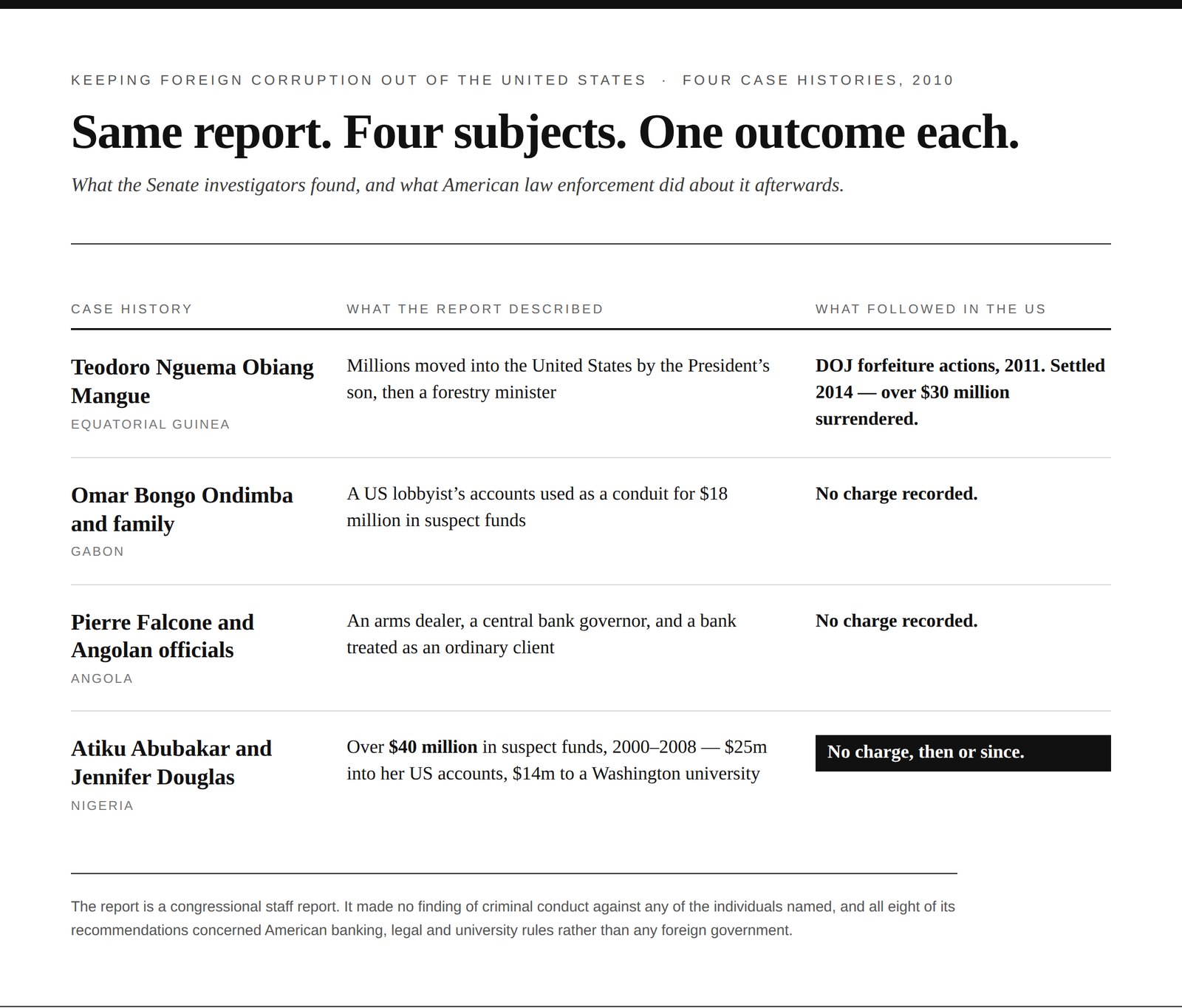
The four case histories were chosen as illustrations of an American regulatory failure. One concerned Teodoro Nguema Obiang Mangue of Equatorial Guinea. One concerned President Omar Bongo of Gabon and his family. One concerned Angola: the arms dealer Pierre Falcone, a central bank governor, and a bank. And one concerned Nigeria.
The Obiang, Bongo and Nigerian case histories alone describe more than $160 million in suspect funds.
The forty million, broken into its parts
The executive summary states it plainly:
“From 2000 to 2008, Jennifer Douglas, a U.S. citizen and the fourth wife of Atiku Abubakar, former Vice President and former candidate for President of Nigeria, helped her husband bring over $40 million in suspect funds into the United States through wire transfers sent by offshore corporations to U.S. bank accounts.”Senate PSI report, executive summary, page 4
Note the construction of that sentence. The actor is Jennifer Douglas. Atiku appears as the person she is helping. And the money is not called stolen, or laundered, or criminal. It is called suspect. (The one exception in the Nigerian chapter is the $1.7 million from Siemens AG, which it calls “bribe payments”. That is the subject of the next article in this series.)
The report offers no formal definition of “suspect funds.” That is less an oversight than the whole posture of the document. These are wires whose origin the investigators could not satisfactorily explain, sent by companies the people receiving the money said they knew little or nothing about, into the accounts of a woman who described herself to her banks as unemployed or a student.
The $40 million splits in two, and this is where many Nigerian retellings collapse:
- Nearly $25 millionwent into more than thirty US bank accounts opened by Ms. Douglas.
- About $14 millionwent somewhere else entirely: to American University in Washington, D.C., between 2003 and 2007, as consulting fees for that university’s work on the school Atiku was building in Yola. It did not go to the American University of Nigeria. That distinction gets its own article in this series, because so many Nigerian accounts of this story have it backwards.
Add at least $2.1 million more wired to accounts controlled by the couple’s Washington lawyer, and that is how the report gets past forty.
The companies
Four names do the work.
- LetsGo Ltd. Inc.A Panamanian corporation, beneficially owned, the report says, by the Italian businessman Gabriele Volpi and his wife.
- Sima Holding Ltd.Registered in the British Virgin Islands, beneficially owned by Volpi, his wife and their sons through a family trust. LetsGo and Sima together sent nearly $27 million into the United States.
- Guernsey Trust Company Nigeria Ltd.Read the full name carefully, because it invites the wrong assumption. This is a Nigerian company, not a Guernsey one, described by the report as “a shell company formed one day earlier under the laws of Nigeria.” According to its lawyers it was incorporated on 9 October 2003, and its three beneficial owners, Volpi among them, provide the trustee services for something called the Abubakar Blind Trust. (Volpi told the Subcommittee the name was “merely a name” with “no special significance.”) It sent at least $10 million.
- China Castle Investments Ltd.Sent $500,000 on 30 January 2003. Citibank told the Subcommittee it had no further information about the company. The report could not even establish where it was incorporated.
The banks, and what they did not know
This is the part of the report that has real teeth, and it is aimed at Americans.
Citibank is the centrepiece: eighteen accounts between 2000 and 2007, through which nearly $20 million in suspect funds passed. Five personal checking, five savings, two brokerage, a home-equity account, three for a foundation, and two more checking accounts later tied to the university.
For most of those seven years, Citibank did not know it was dealing with the wife of Nigeria’s Vice President. The bank’s defence is quoted in the report: “Nothing in Ms. Douglas’s initial application referenced or suggested that she had any connection to a foreign country or had a relationship with any foreign official.” Citibank worked it out in early 2007 and had closed every account by August.
She then opened six accounts at Wachovia, with her lawyer’s help. When Wachovia moved to close them, her lawyer persuaded the bank to give her more time to find another one. There were also four accounts at Chevy Chase Bank and three at Eagle Bank. At SunTrust, the lawyer’s own firm opened an account for the university. And earlier, she held two accounts at Riggs Bank from 1999 to 2005 that received over $5.2 million, followed by a PNC account that took nearly $1.1 million after PNC bought Riggs; the Subcommittee noted those but did not trace them.
You may have read that HSBC handled this money. The report does not say so. HSBC appears in this report in the Gabon and Angola case histories, not the Nigerian one.
The lawyer
The American professional at the centre of the Nigerian case history is not a lobbyist; the lobbyist belongs to the Gabon chapter. It is a Washington-area attorney, Edward Weidenfeld, who first did legal work for Ms. Douglas in 2002 and went on to advise Mr. Abubakar and the university.
The report’s account: he “accepted $3.4 million from offshore entities to pay the Abubakars’ legal bills and to fund an AUN account he opened at Suntrust Bank.” In the first eight months of 2008 alone, over $1.3 million came into his law firm account from the Guernsey Trust Company. He was a signatory on the university account that took another $2 million.
His explanation is the sentence that ought to be taught in every compliance course on earth:
“He told the Subcommittee that he never dealt directly with the Guernsey Trust Company and had no information about the company that sent him millions of dollars, but simply assumed it was providing funds supplied by Mr. Abubakar.”Senate PSI report, page 188
He cooperated with the Subcommittee, voluntarily producing documents and answering written questions. So, notably, did Jennifer Douglas, though she declined an interview. Atiku Abubakar, through counsel, declined to answer any questions at all.
What the report does not do
It makes no finding of criminal conduct by Atiku Abubakar or by Jennifer Douglas. It charges neither of them with an offence, and it refers neither for prosecution. The nearest it comes is a single sentence in its conclusion, and even that sentence is about someone else’s allegation:
“An allegation by the SEC that Ms. Douglas received over $2 million in bribe payments from Siemens AG, intended in part for her husband, also cannot be dismissed.”Senate PSI report, page 243
“Cannot be dismissed” is not “proven”. The one guilty plea connected to the money in the Nigerian chapter belongs to Siemens AG, which had pleaded guilty in the United States to violations of the Foreign Corrupt Practices Act nearly fourteen months before the report appeared.
The report also volunteers its own limits: “The Subcommittee did not attempt to trace all of the funds that went into or out of the accounts discussed below, nor did the Subcommittee examine every U.S. bank account opened by Ms. Douglas.”
And its recommendations, all eight of them, are addressed to American institutions. Congress and the Treasury should put into effect a World Bank study’s recommendations on politically exposed persons. Treasury should repeal the anti-money-laundering exemptions it has granted, including the 2002 exemption for real estate and escrow agents. Banks should have to obtain a certification that attorney-client and law office accounts will not be used to get around those controls. Congress should require anyone forming a US company to disclose its beneficial owners. The American Bar Association, the National Association of Realtors, the American League of Lobbyists and the American Council on Education should each issue guidance to their members.
Not one recommendation concerns Nigeria. Not one asks any agency, American or Nigerian, to investigate Atiku Abubakar.
The sting
Here is where the defenders’ case runs out.
If this report were merely a piece of academic hand-wringing, nothing should have come of it for anyone. That is not what happened.
In October 2011, the US Department of Justice filed civil forfeiture actions against assets belonging to Teodoro Obiang (the Equatorial Guinea case history from the same report, same volume, same investigators), seeking to recover more than $70.8 million. Senator Levin issued a statement applauding the filings and citing his subcommittee’s reports. In October 2014 Obiang settled, agreeing to give up more than $30 million in assets.
So enforcement did follow for one of the report’s subjects. The report cannot claim sole credit, because Obiang was already under Justice Department investigation when it was published, as the report itself noted. But nothing comparable followed in the Nigerian case.
Why not is a question with at least three honest answers, and no way to choose between them from the outside. It may be that prosecutors looked and found nothing chargeable. It may be that the evidence sat on the wrong side of a jurisdictional line: Ms. Douglas answered the Subcommittee’s written questions, Mr. Abubakar did not, and he was not an American. It may simply be that Obiang bought a $38.5 million jet and a glove Michael Jackson wore, and wire transfers to a university do not photograph as well.
There is a recurring Nigerian claim that the Justice Department opened a wire fraud investigation. It appears to trace to a THEWILL story datelined 6 January 2011, which rested on a single Justice Department source who spoke anonymously. The department’s spokeswoman answered every question with “We decline comment.” We could find no indictment, court filing or official confirmation in the fifteen years since, and AFP Fact Check reported in August that the Senate report did not result in any criminal charges against Atiku “either at the time or subsequently.” Treat the claim as what it is: unconfirmed.
What you are left holding
A congressional staff report is not a verdict. Anyone telling you Atiku was convicted, indicted, or “nailed” by the United States Senate is either misleading you or has not opened the file.
But a congressional staff report is also not nothing. Somebody incorporated a Nigerian shell company one day before it took over a sitting Vice President’s blind trust. Companies registered in Panama and the British Virgin Islands sent nearly $27 million into the United States, about $8 million of it into the accounts of a woman who listed her occupation on bank and tax documents as student, homemaker and unemployed. A lawyer took millions from a company he knew nothing about and assumed the money was Mr. Abubakar’s. And the man at the centre of it declined to answer a single question.
And the reason it is still unanswered is not that the document is thin. It is that in sixteen years, nobody in Nigeria with the authority to ask has pressed those questions to an answer.
Next in this seriesThe WatchesSources
- U.S. Senate Permanent Subcommittee on Investigations, Keeping Foreign Corruption Out of the United States: Four Case Histories, Majority and Minority Staff Report, released with the hearing of 4 February 2010 · hsgac.senate.gov · download the report
- The Abubakar case study chapter (Section V), standalone scan · almendron.com
- Senator Carl Levin, opening statement, Permanent Subcommittee on Investigations hearing, 4 February 2010 · hsgac.senate.gov
- Senator Tom Coburn, opening statement, 4 February 2010 · hsgac.senate.gov
- U.S. Department of Justice, “Siemens AG and Three Subsidiaries Plead Guilty to Foreign Corrupt Practices Act Violations and Agree to Pay $450 Million in Combined Criminal Fines,” 15 December 2008 · justice.gov
- U.S. Immigration and Customs Enforcement, “ICE HSI and DOJ seek to recover more than $70.8 million in corruption proceeds from government minister of Equatorial Guinea,” 25 October 2011 · ice.gov
- Statement of Senator Carl Levin on the civil forfeiture actions filed against Teodoro Obiang, 25 October 2011 · hsgac.senate.gov
- United States v. One White Crystal-Covered “Bad Tour” Glove and Other Michael Jackson Memorabilia, No. 2:11-cv-03582 (C.D. Cal.), docket · courtlistener.com
- U.S. Immigration and Customs Enforcement, “Second vice president of Equatorial Guinea agrees to relinquish more than $30 million of assets purchased with corruption proceeds,” October 2014 · ice.gov
- AFP Fact Check, “2010 US Senate report recycled as fresh corruption probe into Nigeria’s former VP,” 14 August 2026 · via Yahoo News
- THEWILL, “USDOJ Investigates Atiku, Wife, Associates Over Wire Fraud,” datelined 6 January 2011, republished 8 January 2011 · via The Nigerian Voice
The allegations described here are allegations. To our knowledge, no United States or Nigerian agency has charged Atiku Abubakar or Jennifer Douglas with a criminal offence in connection with them. Both have denied wrongdoing.