The Watches
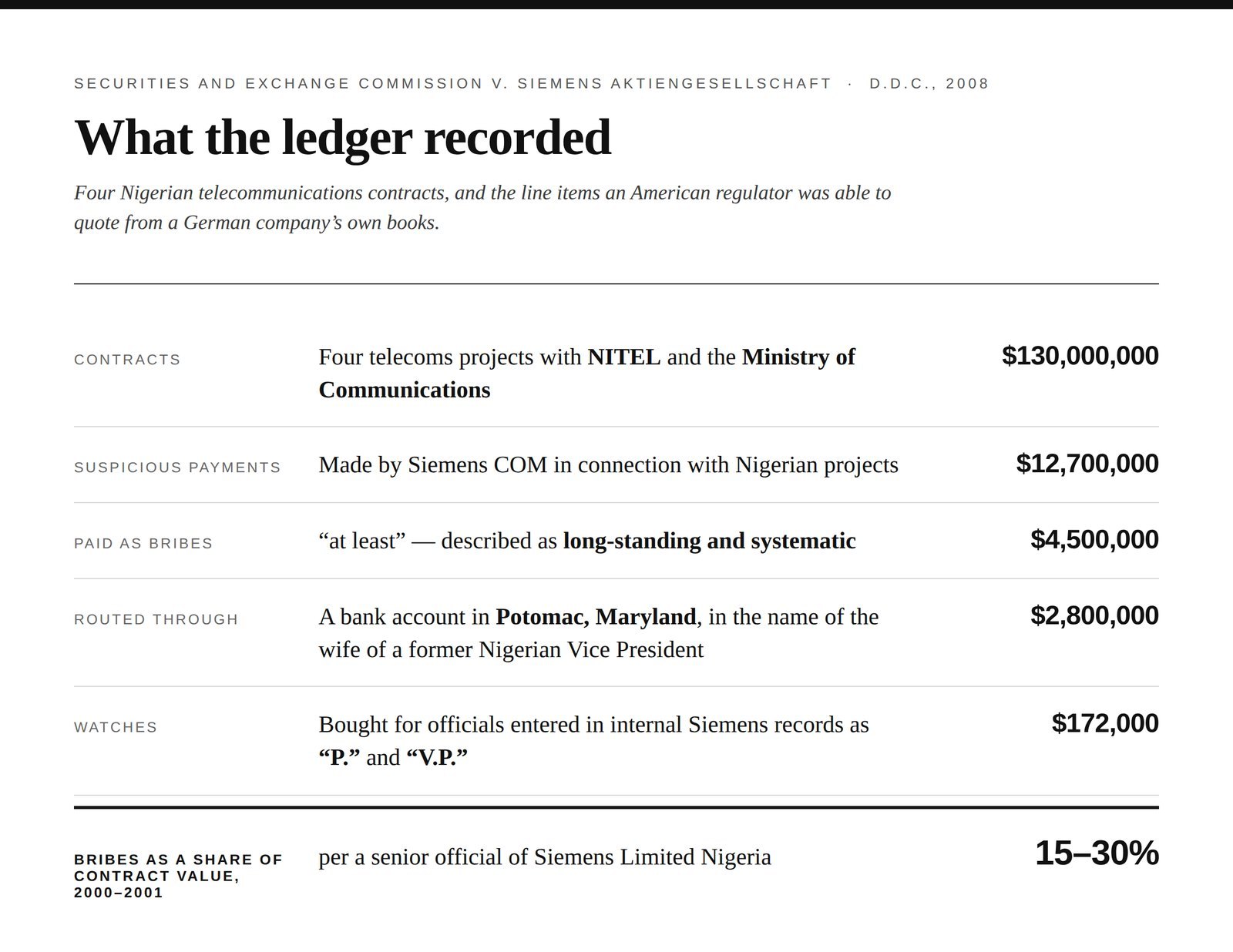
According to the SEC, Siemens bought about $172,000 worth of wristwatches for Nigerian officials and recorded them under two initials: “P.” and “V.P.” Eighteen years later, nobody in Nigeria has ever been made to say who they were.
Of everything in the Atiku Abubakar file, this is the piece that behaves differently.
The rest of it is allegation — suspect wires, unexplained companies, a report that stops short. This one has a defendant who pleaded guilty, a court in Washington, a signed settlement, and a number: more than $1.6 billion.
The defendant is not Nigerian. That is the problem, and it is also the point.
What Siemens admitted
On 15 December 2008, before Judge Richard J. Leon of the US District Court for the District of Columbia, Siemens Aktiengesellschaft pleaded guilty. The Justice Department took $450 million in criminal fines from the company and three of its subsidiaries. The Securities and Exchange Commission took $350 million in disgorgement. The Munich public prosecutor had already taken €201 million the year before and took another €395 million — about $569 million — the same day.
Combined: more than $1.6 billion. The American share alone, $800 million, was in the Justice Department’s words “the largest monetary sanction ever imposed in an FCPA case since the act was passed by Congress in 1977.”
The conduct behind it: at least 4,283 corrupt payments totalling about $1.4 billion between March 2001 and September 2007, on transactions that earned Siemens over $1.1 billion in profit. The SEC’s enforcement director, Linda Chatman Thomsen, called it what it was: “This pattern of bribery by Siemens was unprecedented in scale and geographic reach.”
There is a technicality worth holding onto, because it recurs everywhere in this story. Siemens AG pleaded guilty to two counts — violating the internal-controls and the books-and-records provisions of the Foreign Corrupt Practices Act. Not the anti-bribery provision itself. Three subsidiaries, in Argentina, Bangladesh and Venezuela, took conspiracy counts, and only the Bangladeshi and Venezuelan counts reached the anti-bribery provisions. That is how what was then the largest FCPA sanction in American history was resolved, as far as the parent company was concerned: as an accounting failure.
The Nigerian chapter
The detailed Nigerian allegations are in the SEC’s civil complaint, at paragraphs 49 and 50. The Justice Department’s criminal papers do touch Nigeria: the Statement of Offense filed with the plea records that in 2003 Siemens’ outside auditors found €4,120,000 in cash had been brought to Nigeria by staff of its telecommunications group, and that a company compliance lawyer warned of possible violations of German law, including anti-bribery laws. But the criminal case does not set out the Nigerian bribes, the Maryland bank account or the watches, and no Siemens Nigeria entity was ever charged in the United States. Anyone who tells you Siemens was criminally convicted in America for bribing Nigerian officials is compressing a real thing into a false one.
What the SEC did file reads as follows.
“Siemens COM made approximately $12.7 million in suspicious payments in connection with Nigerian projects, with at least $4.5 million paid as bribes in connection with four telecommunications projects with government customers in Nigeria, including Nigeria Telecommunications Limited and the Ministry of Communications.”SEC v. Siemens Aktiengesellschaft, complaint, ¶49
The four contracts were worth about $130 million.
“The practice of paying bribes by Siemens COM in Nigeria was long-standing and systematic.”SEC complaint, ¶49
And then the sentence that should have ended several careers:
“According to a high ranking official within Siemens Limited Nigeria, a regional company, corrupt payments in 2000 and 2001 commonly reached 15 to 30% of the contracts’ value.”SEC complaint, ¶49
Fifteen to thirty per cent. If that is right, it was not a bribe on the side of a contract. It was a bribe built into the price of a contract, absorbed by NITEL, paid for by whoever was left holding a telephone line in Nigeria in 2001.
“P.” and “V.P.”
Then there is paragraph 50’s other detail, which is the reason this article exists.
“Other corrupt payments included the purchase of approximately $172,000 in watches for Nigerian officials designated in internal Siemens records as ‘P.’ and ‘V.P.,’ likely referring to the President and Vice-President of Nigeria.”SEC complaint, ¶50
Read that again slowly.
A German multinational, according to the SEC, carried a purchase of wristwatches in its own internal records. The recipients were entered under initials that the SEC read as ranks rather than names. And the ranks, in the years in question, had occupants — the office of President of Nigeria was held by Olusegun Obasanjo, and the office of Vice President by Atiku Abubakar.
Here is where care is owed, and where much Nigerian commentary abandons it. The SEC did not name anybody. It said likely referring to. It is the American regulator’s inference from a German company’s shorthand, and it is an inference, not a finding. We could find no record that either office-holder has been charged over, publicly questioned about, or asked on any record to account for a watch.
But note what did not happen either. In eighteen years, we could find no public record of any Nigerian institution going to Siemens and asking the obvious question: who took delivery? The company kept records detailed enough for the SEC to quote them.
Potomac, Maryland
The same paragraph contains the other number.
“In the four telecommunications projects, approximately $2.8 million of the bribe payments was routed through a bank account in Potomac, Maryland, in the name of the wife of a former Nigerian Vice President.”SEC complaint, ¶50
The paragraph goes on to say that the Vice President’s wife, “a dual U.S.-Nigerian citizen living in the United States, served as the representative of a business consultant that entered into fictitious business consultant agreements to perform ‘supply, installation, and commissioning’ services but did no actual work for Siemens. The purpose of these payments was to bribe government officials.”
That is the SEC’s language, in full, and it is the entire extent of what the complaint says about her. The complaint’s caption reads Securities and Exchange Commission v. Siemens Aktiengesellschaft and nothing else.
No individual is a defendant. No individual is a relief defendant. Jennifer Douglas is not named anywhere in it.
Her name was attached to that description by others. Within two weeks of the filing, Harper’s Magazine’s Ken Silverstein wrote that “it seems clear from public accounts that the person in question is Jennifer Atiku-Abubakar,” while stressing that he had “no way of knowing whether the charges made in the complaint about her are accurate.”
The official attribution came two years later, and from a different direction. In his opening statement at the Senate hearing of 4 February 2010, Senator Carl Levin put it on the record: Ms. Douglas “is alleged in a 2008 civil complaint filed by the Securities and Exchange Commission to have received $2.8 million in bribe payments from a German conglomerate, Siemens AG.”
That attribution is Levin’s, not the SEC’s. It is how a description in a regulator’s filing became a name in the official record — through a United States senator’s statement at a hearing, under privilege, with no legal consequence attaching either way.
The three wires
The Senate subcommittee went looking for the money itself. It found three wire transfers from Siemens AG into Ms. Douglas’ personal checking account at Citibank, account 52096374, in Potomac, Maryland:
- 12 April 2001$450,703.79
- 1 October 2001$461,440.92
- 28 January 2002$860,500.00
Total: $1,772,644.71. Levin summarised it as “three wire transfers substantiating $1.7 million in payments from Siemens to Ms. Douglas in 2001 and 2002.”
This is why you see two figures quoted for the same thing, and why treating them as rival versions is a mistake. $2.8 million is the SEC’s figure for what was routed through the Potomac account. $1.7 million is what Senate investigators independently obtained the wire records for, and the subcommittee described those records as substantiating the SEC’s allegation. Siemens also told the subcommittee that its outside law firm, Debevoise & Plimpton, had confirmed a further wire transfer to her at another bank, plus nearly $2 million in additional cash payments between 2000 and 2003. The numbers do not compete. The Senate’s wires document part of the SEC’s figure, and the cash, on Siemens’ own account, came on top.
Four days after the largest of the three wires landed — $860,500 on 28 January 2002 — $250,000 moved out into a newly opened account at Chevy Chase Bank in the name of the Gede Foundation, a charity Ms. Douglas had incorporated three days before that wire arrived.
The answers, and the absence of them
Jennifer Douglas has denied wrongdoing throughout. Her position, through counsel, was that she had no personal knowledge of the offshore entities and understood that anything reaching her accounts from them came from her husband.
That answer works for LetsGo and the Guernsey Trust Company. It works less well here, because Siemens is not a little-known offshore company. It is a listed German industrial giant that pleaded guilty in an American court, and it confirmed to the Senate subcommittee that the SEC’s allegation referred to payments it had made to her. When the subcommittee showed her counsel the Siemens wire transfers and asked for an explanation, none was offered.
Atiku Abubakar, through his legal counsel, declined to answer any of the subcommittee’s questions. We could find no public rebuttal from him addressed to the Siemens payments specifically. His standing line covers everything at once, and he repeated it this month, in a statement issued through his aide Phrank Shaibu and reported on 5 September: “Yet no court convicted me on these allegations. That is the record,” and “Anyone with credible evidence against me should bring it out and test it before the law.”
The first is true. The second is a fair challenge. Neither is an account of what the money was for.
What Nigeria did with it
This is the part that should make a Nigerian reader put the paper down.
In October 2010 the EFCC filed charges in Abuja against Siemens Ltd. Nigeria, Siemens AG, and former board members of the Nigerian company. On 23 November 2010, before Justice Danlami Senchi of an Abuja high court, it arraigned four Nigerians on a sixteen-count amended charge: Maigada Shuaibu, a former director of the Power Holding Company of Nigeria (PHCN); Edwin Moore Momife, former M-Tel chief executive; Emmanuel Chukwuemeka Ossai, former general manager for finance at NITEL; and Mahmood Sadiq Mohammed, former permanent secretary at the Federal Ministry of Power and Steel. Among the inducements alleged: air tickets for them and their families to the FIFA World Cup in Germany, and frequent sponsored trips to Germany for medical check-ups.
All four pleaded not guilty. All four were released on self-recognisance.
And then the court file goes quiet. We could find no reported judgment, no conviction and no acquittal. The only later word we could find came from outside the courtroom. In April 2013 a civil-society group, the Anti-Corruption Network, pressing President Goodluck Jonathan to dismiss his Attorney General, Mohammed Bello Adoke, listed among its complaints that in November 2010 the Attorney General had “ordered EFCC to terminate the criminal case filed against” the four men “after EFCC had docked them.” We could find no court record confirming that the charges were formally withdrawn, and no official account of why. Four men were arraigned in a Nigerian court in a case connected to what was then the largest foreign-bribery penalty in American history, and the public record offers nothing more than a campaign group’s account of how it ended.
The day before that arraignment, on 22 November 2010, the Federal Government settled with Siemens out of court. Vanguard reported that the Attorney General had that Monday invoked his powers under section 174 of the Constitution to order the EFCC to terminate its case against Siemens AG, its Nigerian subsidiary and “four of its principal staff.” Siemens’ own account of the deal, in its 2011 annual report filed with the SEC and reproduced in the World Bank’s asset-recovery database, is admirably clear about what it bought: a payment “in the mid double-digit € million range to Nigeria in exchange for the Nigerian Government withdrawing these criminal charges and refraining from the initiation of any criminal, civil or other actions—such as a debarment—against Siemens Nigeria, Siemens AG, and Siemens employees.”
Nigerian press at the time put the figure at ₦7 billion, which Pointblank News gave as €30.5 million. The written terms were never published. A 2014 study by the Stolen Asset Recovery Initiative, the World Bank and UN Office on Drugs and Crime partnership, describes the payment only as “an unspecified large sum” and notes that the terms “have remained confidential.” As far as we can tell, nobody has asked for them.
So the corporation paid and walked. Four Nigerian officials were charged and, on the public record, simply disappear from it. Whoever was logged as “P.” and “V.P.” was never, so far as any public record shows, approached at all.
The uncomfortable arithmetic
Strip it down.
Siemens pleaded guilty in Washington, and its criminal papers record cash carried into Nigeria. An American regulator alleged that $2.8 million in bribe payments was routed through a bank account in Maryland in the name of the wife of a former Vice President. Siemens confirmed to Senate investigators that the allegation referred to payments it made to her. Those investigators obtained the wire records for $1.7 million of it and published the dates and the cents. Siemens told them its outside lawyers had confirmed more went through another bank and in cash.
Against that: no charge over any of it, anywhere, against her or him. We could find no sign that any Nigerian agency has asked Siemens who wore the watches, or that any Nigerian court has heard a word of it. The corporate case was settled away on terms the country has never been shown.
The people who say Atiku was convicted over Siemens are wrong, and demonstrably so.
The people who say the matter was investigated and closed are also wrong, and more importantly so — because nothing was closed. It was purchased, dismissed, or simply allowed to lapse, depending on which strand you follow, and every one of those is different from being tested.
Somewhere in Siemens’ records there is an entry with two initials in it. That is not proof of anything. It is an unanswered question with a price tag of $172,000, and the reason it is still unanswered has nothing to do with how hard the answer would be to find.
Next in this seriesThe $14 Million Did Not Go to YolaSources
- SEC v. Siemens Aktiengesellschaft, complaint, D.D.C., filed 12 December 2008 · sec.gov (PDF) · download the complaint
- SEC, press release 2008-294, “SEC Charges Siemens AG for Engaging in Worldwide Bribery,” 15 December 2008 · sec.gov; Litigation Release 20829 · sec.gov
- US Department of Justice, press release 08-1105, “Siemens AG and Three Subsidiaries Plead Guilty to Foreign Corrupt Practices Act Violations and Agree to Pay $450 Million in Combined Criminal Fines,” 15 December 2008 · justice.gov
- US Department of Justice, United States v. Siemens Aktiengesellschaft, Statement of Offense, December 2008 · justice.gov (PDF)
- U.S. Senate Permanent Subcommittee on Investigations, Keeping Foreign Corruption Out of the United States: Four Case Histories, 2010 · hsgac.senate.gov (PDF) · download the report; Abubakar case history chapter · almendron.com (PDF)
- Senator Carl Levin, opening statement, Permanent Subcommittee on Investigations hearing, 4 February 2010 · hsgac.senate.gov (PDF)
- Ken Silverstein, Harper’s Magazine, “William Jefferson Scandal Link to Siemens Bribery Investigation?,” 24 December 2008 · harpers.org
- Vanguard, “Siemens Scandal: EFCC docks Maigada, Momife, 2 others,” 23 November 2010 · vanguardngr.com
- Siemens AG, Annual Report on Form 20-F for fiscal year 2011 (legal proceedings: Nigeria), filed with the SEC · sec.gov
- World Bank / UNODC Stolen Asset Recovery Initiative, Asset Recovery Watch, “Siemens AG (Nigeria chapter)” · star.worldbank.org
- Stolen Asset Recovery Initiative, Left out of the Bargain: Settlements in Foreign Bribery Cases and Implications for Asset Recovery, 2014 (case summary 12, Siemens AG) · unodc.org (PDF)
- ThisDay, “Bribe Scandal - Siemens Fined N7 Billion,” 22 November 2010 · via allAfrica
- Pointblank News, “Bribery Scandal: Siemens to pay Nigeria N7 billion in damages,” 17 November 2010 · pointblanknews.com
- Sahara Reporters, “Anti-Corruption Network Reminds President Jonathan He Has Yet To Fire AGF Mohammed Adoke,” 11 April 2013 · saharareporters.com
- Leadership, “Atiku Fights Back As Ex-Rep Asks EFCC To Reopen 20-year-old Case,” 5 September 2026 · leadership.ng
The allegations described here are allegations. Siemens AG’s guilty plea is a matter of record; no individual named or described in this article has been charged in the United States in connection with it. The four Nigerian officials arraigned by the EFCC in 2010 pleaded not guilty, and we found no record of a conviction. Jennifer Douglas has denied wrongdoing. Atiku Abubakar has consistently denied wrongdoing and has never been charged in connection with the Siemens payments.